
Criminal Court Cases in Baker County
Baker County is part of Florida's six-county Eighth Judicial Circuit. Circuit Court hears felony prosecutions. Baker County Court hears misdemeanors, criminal traffic, and other county-level matters. The circuit's master calendars separate Baker Circuit Court and Baker County Court, which makes the court level a key search choice. An arrest label does not decide that level. The prosecutor's filed charge and its degree do.
The Baker County Clerk of Circuit Court and Comptroller keeps both trial-court dockets and their filed documents. This differs from a sheriff report, which describes what an officer alleged, and from an FDLE history, which assembles reported Florida criminal-history cycles. Baker County court records are the direct source for arraignments, motions, pleas, charge-level outcomes, judgments, and sentences.
Baker County Court Case Levels
Florida's offense degree points readers toward the right Baker County criminal docket. Capital, life, first-, second-, and third-degree felonies belong in Circuit Court. First- and second-degree misdemeanors belong in County Court. A shorthand such as F3 or M1 states the alleged offense class. It does not state whether the charge ended in dismissal, a plea, acquittal, or conviction.
| Court | Typical criminal matters | What to verify |
|---|---|---|
| Baker Circuit Court | Felony prosecutions | Information or indictment, count degree, disposition, sentence |
| Baker County Court | Misdemeanors and criminal traffic | Complaint, court dates, plea, charge-level outcome |
Charges can change after an arrest. Search both the correct court division and each count rather than treating the booking label as the final accusation. The Clerk remains the neutral custodian, while the State Attorney files and prosecutes charges.
Baker County Case Record Searches
Start with the Baker Clerk's Records Search or court-docket route. A full legal name plus an approximate filing year reduces false matches. A case number is stronger. If a public view hides the needed image, the registered-user form or Clerk counter is the next channel. Master calendars help confirm upcoming proceedings, but they are not complete case histories.
- Gather the full name, filing year, and case number when known.
- Choose Circuit Criminal or County Criminal based on the filed matter.
- Match the case style and filing date before opening the docket.
- Read every count and its dated entries, not just the overall status.
- Call the Clerk for a plain, certified, or electronically certified copy.
| Public case field | Type | Required | Use |
|---|---|---|---|
| Case number | Text | No | Best direct identifier when known |
| Case style or party | Text | No | Match full name and party role |
| Court or division | Choice | No | Separate Circuit from County Criminal |
| Filing date | Date | No | Narrow records with similar names |
| Docket sequence | Entry list | No | Read events in filing order |
Do not enter a booking number, FDC number, or FDLE identifier as if it were a Baker County case number. Each belongs to a different record system.
Baker County Registered Docket Access
The Baker Clerk offers registered electronic court-record access under Florida's court security rules. The application asks for name, email, street address, city, state, ZIP code, and phone. It also provides an alternate-phone field. Role choices include registered user, party, authorized representative of a named business entity, and attorney of record. Party cases, business details, or a Florida Bar number apply when the chosen role requires them.
Registration does not make every Baker County criminal case image public. Anonymous, registered, party, and attorney views may expose different material. Maintenance, power, network, or security events can also interrupt service. A blank or unavailable image is not proof that the filing vanished.
The Clerk's records-custodian contact provides the fallback when access fails.
The contact route matters most for restricted images, older paper files, copy quotes, and records that need certification.
Note: A no-result means no public result was found; spelling, filing delay, restricted material, older files, or a portal outage may explain it.
What a Criminal Case File Contains
A Baker County court case file is organized by case number and docket. The charging instrument may be an information filed by the State Attorney or an indictment returned by a grand jury. Later entries can show hearing notices, motions, amended counts, pleas, trial events, judgments, and postjudgment filings. Document access may differ from the public index.
| Case number and court | Identifies the Baker Circuit or County Court file and division. |
|---|---|
| Charging document | Shows the prosecutor-filed information, indictment, complaint, and counts. |
| Docket entries | Lists filed events in date and sequence order. |
| Hearing dates | Shows scheduled event type, date, and time when publicly available. |
| Disposition and judgment | Records each count's outcome and formal adjudication. |
| Sentence and conditions | States the court-imposed term, supervision, restitution, or other conditions. |
Bond is a pretrial release condition, not a sentence or fine. Likewise, case status and count outcome are different fields. Read them together.
Read Baker County Dockets Carefully
A single Baker County criminal case can show a filed charge, an amended charge, a dismissal, and a conviction on different counts. “Closed” only describes case administration. It can follow a dismissal, plea, trial, transfer, or another type of closure. “Pending” means unresolved when viewed and is not proof of guilt.
- Nolle prosequi
- The prosecutor discontinues a charge.
- Adjudication withheld
- A Florida outcome in which the court withholds a conviction after a plea or finding, subject to law.
- Acquittal
- A not-guilty result.
- Disposition
- The outcome of a case or individual charge.
- Capias
- A court command to take a person into custody.
Compare the outcome for each count with the date and source label. An arrest charge, prosecutor-filed charge, and conviction offense can all differ. The broader Baker County arrest search addresses the earlier booking record, while the Clerk file answers what happened in court.
Criminal Case Stages in Baker County
A Baker County criminal case may begin with arrest or summons. For a person in custody, first appearance addresses rights, probable cause, and pretrial release. It is not a trial. Prosecutor review follows, then an information or indictment sets the filed counts. Arraignment is the formal plea stage. Discovery, motions, a negotiated plea, or trial may come next.
Case flow: Charges Filed › Arraignment › Pretrial › Plea or Trial › Disposition › Sentencing
The court may then enter a verdict or plea result, adjudication, sentence, and later postjudgment motion. An appeal creates a separate appellate record, but the underlying Baker County trial file remains with the Clerk.
Baker County First Appearance Records
Eighth Judicial Circuit Administrative Order 4.03 provides a weekday Baker first-appearance session at 1 p.m., subject to the current weekly calendar. Weekends and holidays use centralized video arrangements through Gainesville. In-custody defendants may appear remotely from Baker detention. Some County Court criminal dockets also permit hybrid proceedings.
Florida Rule of Criminal Procedure 3.130 governs prompt first appearance. The hearing deals with rights, probable cause, counsel, and release. Later docket events determine the prosecution's outcome. A calendar entry shows scheduling, not a full history, so confirm what occurred through the docket and filed orders.
Note: Court calendars can change, and a remote appearance does not alter the Clerk's role as custodian of the resulting Baker County record.
Baker County Recordings and Appeals
For a hearing transcript or audio recording, provide the case number, proceeding date, judge or division, and hearing type to Eighth Circuit court reporting. Public recordings are redacted. Unredacted recordings are limited to parties and attorneys and may not be shared. The circuit states a $24-per-hour redaction charge, so request a quote before ordering.
The Florida Appellate Case Information System, or ACIS, applies only after a matter reaches the Florida Supreme Court or a District Court of Appeal. It does not replace the Baker Clerk's trial docket. Public ACIS options include Case Search, Party Search, Oral Argument Search, and Advanced Search.
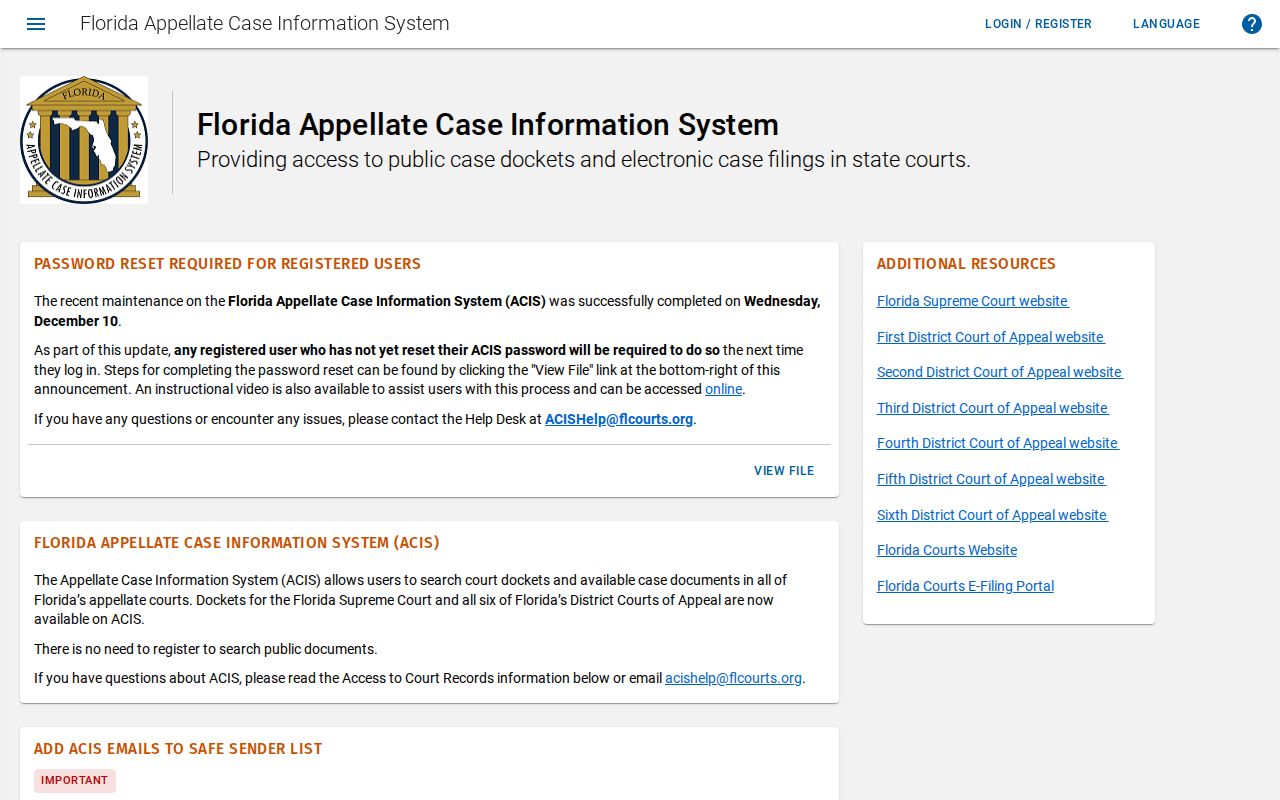
The appellate view tracks the appeal and public documents, while the Circuit or County Court file remains the source for Baker County trial events.
Access Rules for Case Records
Florida court records start from a presumption of access, but confidentiality rules protect specific material. Florida Rule of General Practice and Judicial Administration 2.420 governs judicial-record access. Juvenile information, protected victim details, sealed or expunged matters, exempt identifiers, and some images may be withheld. An index can remain visible while its document image is restricted.
The Baker County Courthouse and Clerk counter are at 339 East Macclenny Avenue, Macclenny, Florida 32063. The main line is 904-259-8113. Official pages report both 8 a.m. to 5 p.m. office hours and 9 a.m. to 4:30 p.m. public-counter assistance, so call before travel. Ask for the exact docket entry, state whether a plain or certified copy is needed, and request a quote because no Baker criminal-copy fee schedule was found in the official research.
Judicial chambers cannot conduct a Baker County court case lookup, give legal advice, or discuss a pending matter. Send record questions to the Clerk, not the judge.